The first fruits of our project on Low Energy Nuclear Reactions.
Current day science and NDT will be highly benefited by a compact neutron source of moderate intensity and costs. During the last months we have been researching what such a neutron production would look like, based on Low energy nuclear reactions (LENR).
Typical neutron production relies on fission or fusion. The former requires a high-cost nuclear reactor, and fusion requires a high kinetic energy of the fusing particles to overcome the Coulomb barrier (hot-fusion). However, there are other ways to overcome the Coulomb barrier. Formerly known as cold-fusion, nowadays as LENR, experiments show that this type of fusion can be used to create neutrons. Even though the method is more complex, the equipment needed is much simpler and thus more cost-effective in comparison to hot-fusion or fission reactors.
Through an extensive literature review in the first phase of this project, different routes were investigated to produce neutrons with LENR. A list of the known methods, such as fusion by means of accelerators, discharges, sound, and lasers, was established including (dis)advantages. The chosen methods were deemed theoretically sound, but not all were based on established nuclear theories. In the latter case, they were based on verifiable alternatives.
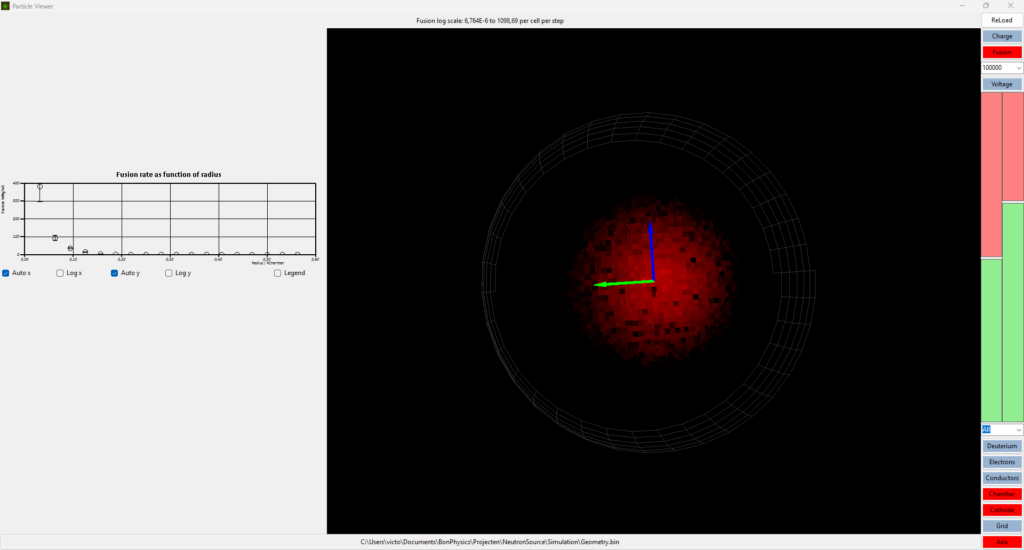
As the ultimate goal of this project is to identify a way to create a relatively affordable and simple LENR neutron source, and taking into account the results from the literature review, we chose to develop a particle simulator. (See screenshots below) This simulator enables the full electrodynamic simulation of an electrostatic fusor. It is also capable of tracking the positions of electrons and ions in an arbitrary geometry and potential. Which in turns leads to the opportunity to examine whether certain potentials produce exotic ion/ charge structures, which may amplify fusion.
In this simulation the fusion rate is calculated using a simple Bosch-Hale model, the fusion cross section is based on empirical observations of the fusion rate against Centre of Mass energy. As a result, the simulator is able to detect: exotic charge structures / destinies and energetic anomalies. A separate simulation will be required to calculate the modified fusion cross section in the case that an exotic structure is identified.
Now we can work with the simulator, we will test and calibrate it against known geometries. After that we can optimize geometries with the help of this simulation suite, bringing us yet another step closer to the identification of a non-complex, well-affordable LENR neutron source with market potential.
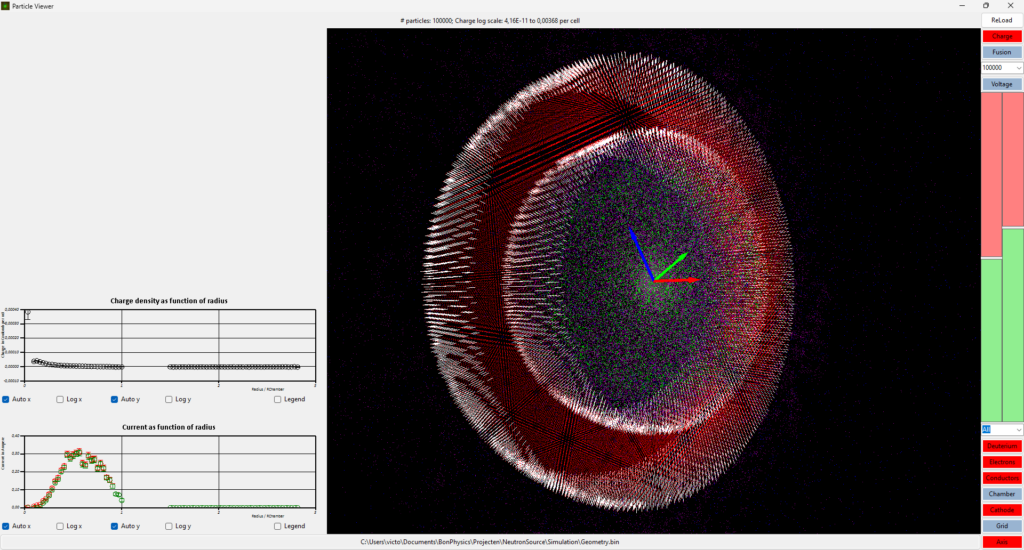
The simulator testing phase in progress...
Research into energy for the future is ongoing and so many resources are spent. The stakes are high and the needs are strong. Therefore I do not understand why not more resources are spent on the most promising energy source under investigation today.
What I refer to is the emerging technology known today as ‘Low Energy Nuclear Fusion’, once described as Cold Fusion.
This technology is now on the break through, but still needs lots of material research and technology development. The development is ongoing since the 1989 publication of Fleischmann and Pons, and will take another century unless more resources and more interest is spent in the development of these processes. Some work has been done, is being done and will be done (several EU and USA grants have been supplied) but the magnitude of the work being done is only a fraction of what is possible and what is warranted given the current situation of the energy supplies in the world.
Therefore, I call upon our governments, universities and businesses to take the development of this technology more serious. The task is not small, but the possible rewards are huge, as long as we try to use the technology wisely.
The way forward it to select 3 or 4 possible processes that have been developed, and select an expert team that will investigate these and find ways to develop scientific proof and technological deployment. Both formidable tasks, but with sufficient interest, manpower and resources the results will be extremely rewarding.
So, I call upon those who read this message: The support of the development of this new technology will benefit us all.
“CleanHME shall develop a new, clean, safe, compact and very efficient energy source based on Hydrogen-Metal and plasma systems, which could be a breakthrough for both private use as well as for industrial applications. The new energy source could be employed both as a small mobile system or alternatively as a stand-alone heat and electricity generator. We plan to construct a new compact reactor to test the HME technology during the long-term experiments and increase its technology readiness level. A comprehensive theory of HME phenomena shall be worked out as well. This project has received funding from the European Union’s Horizon2020 Framework Programme under grant agreement no 951974…”
American team:
“The U.S. Department of Energy (DOE) today announced $10 million in funding for eight projects working to determine whether low-energy nuclear reactions (LENR) could be the basis for a potentially transformative carbon-free energy source. The teams selected today—from universities, a national laboratory, and small business—aim to break the stalemate of research in this space…“