Exactly one week a go, Bonphysics B.V. visited the Embassy of the Republic of Kazakhstan, The Hague. Victor was invited to give a presentation about his field of activity and his thoughts about what steps are now needed in this field.

Slider with alias embassy1 not found. There is nothing to show here!

Our journey in Norway is continuing as we are asked to build a ‘Van Well Chopper’. Since the 1st of August, 2017, we have been supporting the renewal of the instrument suite of the research reactor JEEP-II at the Institute for Energy Technology in Kjeller. Among other things we provided support during the development of a new reflectometer: FREYJA.
For this occasion we will work together with Reactor Institute Delft to build a neutron chopper. A chopper is needed, to use the TOF (Time Of Flight) method in the FREYA reflectometer to detect the wavelength of neutrons.
The working mechanism of this device is based on cutting a neutron beam into pieces. Hereby small groups of neutrons are created sequentially. Because the distance that is travelled by these groups is known and the time of arrival at the detector of each individual neutron can be measured, the neutrons velocity can be determined, which is inversely proportional to their wavelength. In the picture below, a preliminary sketch of the ‘Van Well Chopper’ can be seen and here an animation of the working mechanism can be found.

Slider with alias preliminarysketch not found. There is nothing to show here!
Projects – Website BonPhysics Research and Investigations BV

Categorie: Projects

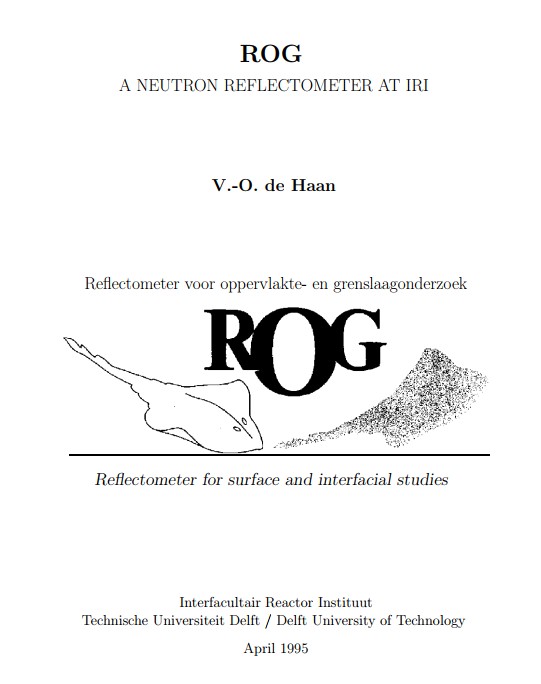
  • ROG going strong after more than 30 years

    It is very rewarding to know that the instrument that I helped developing during my PhD at the Reactor Institute Delft (RID) is now finally reaching its ultimate performance because of the installation of a Cold Neutron Source (CNS) at the Hoger Onderwijs Reactor (HOR) at the same institute.
    Even more rewarding is the fact that I was able to contribute to the OYSTER project that enabled the installation of the CNS. The current director of RID explains (in Dutch): “We hebben het afgelopen jaar flink aan de weg getimmerd”, vertelt Koppers. “Het eerste jaar laat zien dat de koude bron zeer stabiel is en daarmee een mooie constante bron van langzame neutronen levert waar onderzoekers gebruik van kunnen maken.” De koude bron blijkt na een jaar functioneren zeer stabiel en werkt boven verwachting. “We hebben nu tot honderd keer meer het aantal neutronen tot onze beschikking voor onderzoek en dat betekent dat we veel meer onderzoekers kunnen faciliteren. Niet alleen vanuit ons eigen instituut, maar ook vanuit Europa”, aldus Koppers.
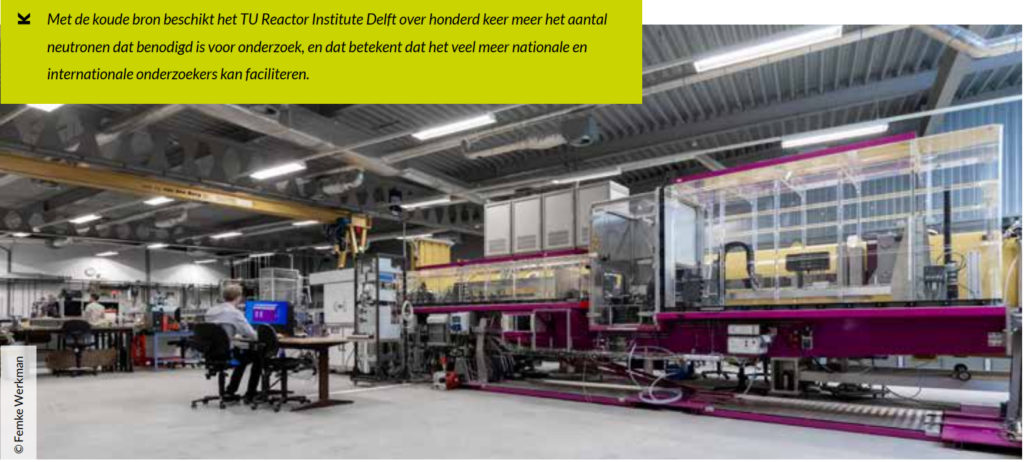
    Source: KernVisie Magazine, Jaargang 20, Nummer 6, December 2025

  • The end of an era!

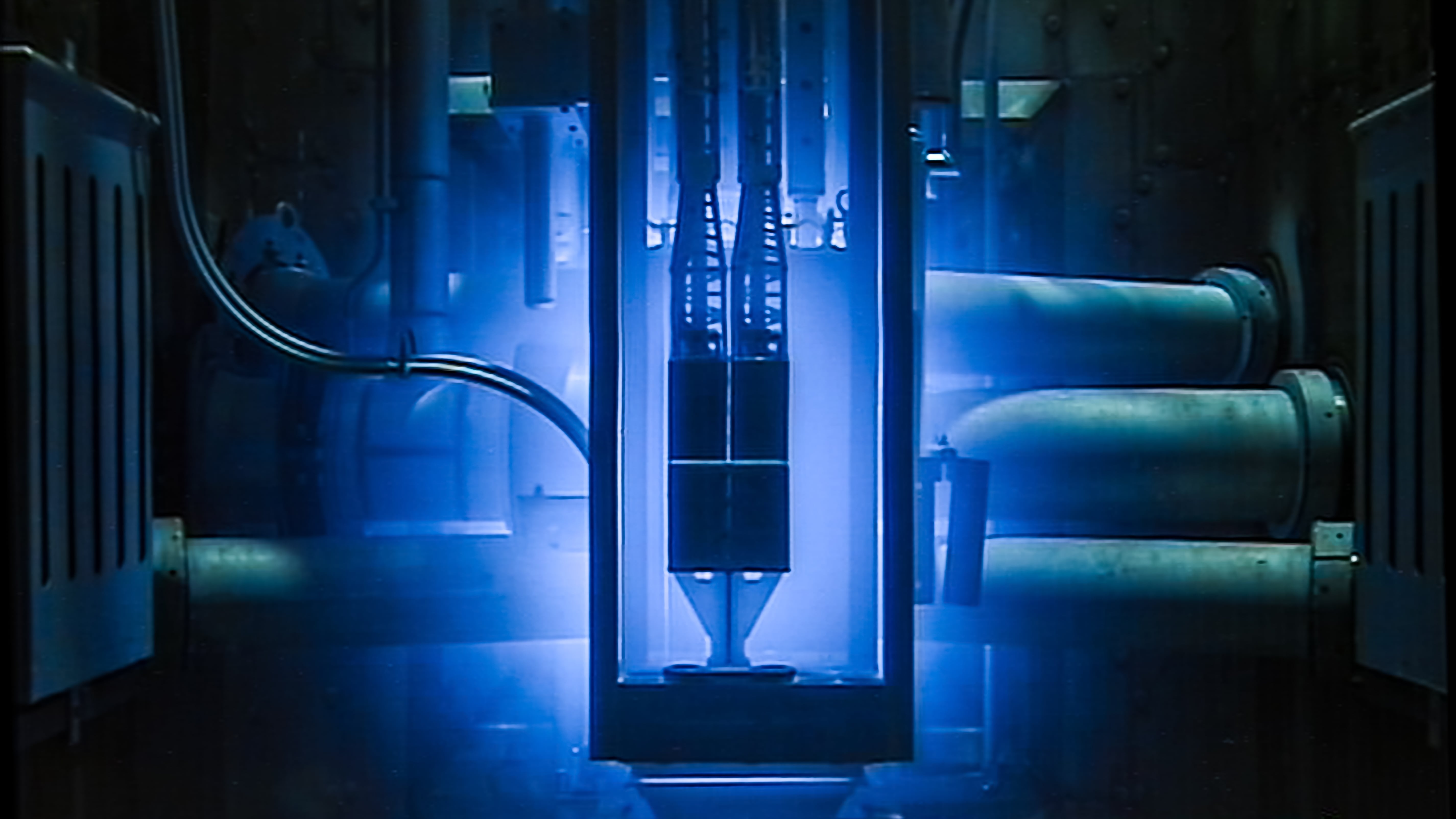
    Over the last years Victor was weekly involved in the OYSTER project at the Technical University of Delft. An international team worked together to develop a cold neutron source, and now it is in function! With the insertion of an extremely cold liquid hydrogen cold source in a beam tube close to the reactor core, the TU Delft is now one of the few research-reactors in Europe with such a source. The cooled neutrons have more interaction with the objects under investigation than non-cooled neutrons. Hence, the quality and speed of measurements can be improved by 100 fold. Therefore, the project under the acronym OYSTER, which stands for Optimized Yield – for Science, Technology and Education – of Radiation, has now been successfully concluded.

    To read more on the OYSTER project & the cold neutron source, click here!

  • A compact neutron source

    Currently, BonPhysics BV is developing a compact neutron source. This is done in cooperation with Norront AS, located in Norway. In this animation the working mechanism is visualized. Do not hesitate to contact us, if you have any questions or remarks!

  • Gravitation-induced quantum interference for neutrons

    About two weeks ago, Victor presented the theory regarding gravitation-induced quantum interference for neutrons, in Vienna. Here you can find the powerpoint he used, including all formulas and explanatory figures. Moreover he explained the plans for future management of spin-gravity coupling at OffSpec, in July 2019.

  • GOOSE

    GOOSE, a guard of the cold neutron source, uses the Larmor precision (read more) to check the performance of the cold neutron source. The (cold) neutron source produces slowly moving neutrons that enter the GOOSE apparatus in which the wavelength spectrum is measured. The ratio of the spectrum intensity after and before the installation represents the gain factor, hence the name of the instrument: ‘Gain Of Oyster Spectrometer Equipment’.

    The Larmor precession, named after Joseph Larmor, is a precession of a magnetic moment of an object in an external magnetic field. An example of such an object is a neutron, a particle that is comparable to a spinning top (read: ‘A new project’) that turns its magnetic moment around a magnetic field.  GOOSE actually is built from several components. The neutron beam is defined by two diaphragms (D1 and D2 in the figure). This beam first passes the monitor (M in the figure). In the monitor, the initial intensity of the neutron beam is determined. 

    Then, it passes the polariser (P) where the neutrons magnetic moment is selected. After the polariser all neutrons that enter the magnetic field (B) have their magnetic moments into the same direction. Since not all neutrons are moving equally fast, the time spent in the magnetic field differs per neutron. After the magnetic field region the neutrons pass the analyser, where they are transmitted or absorbed depending on their magnetic moment. Finally the neutrons that were transmitted are detected (D in the figure). The count rate depends on the direction of their magnetic moment before entering the analyser. All neutrons that are deviating from the ‘set’ direction, will be removed from the beam. The number of turns the neutrons magnetic moment make depend on the magnitude of the magnetic field and the velocity of the neutron, hence by scanning the magnetic field a spectrum of the Larmor frequencies available in the beam will be made.

  • A new project

    Together with researchers from the USA and UK, Victor de Haan has submitted a research proposal regarding gravitation. Gravitation is a force, everyone on the earth has to deal with. Highly relevant information, such as: the actual source of origin of gravitation, is still missing. Although several theories about the origin exist, each one consists of diverse properties. 
    To discover more about this subject, one has to look at the effects of gravity on a quantum system. This is what Victor and his colleagues are going to do. An example of a quantum system is a neutron. A neutron is a very small package and can be described in different ways: as a particle with mass or as a wave. To be able to explain what exactly Victor and his colleagues are going to investigate, a neutron will be compared to a spinning top:

    Already conducted experiments on this subject, however not entirely accurate, seem to show that neutrons with a certain spin undergo a less fast acceleration, caused by gravity, than neutrons with an opposite spin. A spinning top can rotate in two directions: left and right (spin) and the gravitation also effects it. Imagine yourself throwing a spinning top in the air while it rotates left and another spinning top, with the exact same properties, while it rotates right. You might observe that the spinning top with the spin to the left, falls back slower to the ground than the one with the spin to the right. If the proposed measurements indeed show that this is the case (with neutrons), some of the existing theories about the origin of gravity become less plausible than others. This will eventually lead to a better understanding of the origin of gravity.